
-

FROM 800G TO 1.6T : SCALING OPTICAL MODULE TESTING
Read moreITECH High-Density, Modular Test Solutions for High-Speed Optical Module Manufacturing.
-
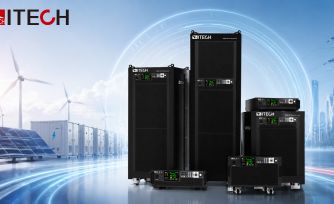
The Inflection Point in New Energy Battery Testing From BMS to Energy Storage PCS: Testing Challenges and Technology Trends
Read moreThe new energy battery industry is undergoing a profound transformation—from scale expansion to technology-driven upgrades. With solid-state battery pilot lines entering production in 2026, the global Battery Management System (BMS) market projected to exceed USD 14 billion, and Power Conversion Sy ...
-
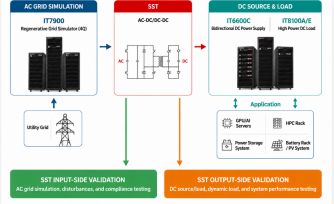
FROM AI COMPUTING TO 800V DC WHY SST VALIDATION MUST COME FIRST
Read moreAI is driving data centers toward higher power density and 800V DC architectures. Solid-State Transformers (SSTs) are becoming a key technology connecting medium-voltage grids, DC buses, energy storage systems, and high-density loads. The commercialization of SSTs depends not only on devices and top ...
-
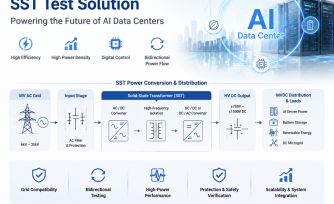
ITECH Solid-State Transformer (SST) Test Solution for AI Data Centers and MVDC Power Infrastructure
Read moreEnabling Reliable Validation of Next-Generation AI Power Systems with Advanced SST Testing Technologies
-
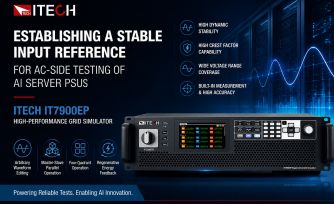
Establishing a Stable Input Reference for AC-Side Testing of AI Server PSUs: ITECH IT7900EP High-Performance Grid Simulator
Read moreIntroduction The power density of AI servers is increasing rapidly. Rack-level power consumption is evolving from tens of kilowatts in traditional servers to over 100 kW, and power architectures are transitioning from 48 V systems to 800 V HVDC. In this process, AC-side testing of AI server power s ...
-
How to Meet the Low-Voltage, High-Current Dynamic Response Testing Requirements of AI Server DC-DC Converters — ITECH IT8100A/E High-Performance Electronic Load Solution
Read moreDriven by the exponential growth in AI computing demand, data centers and AI servers are undergoing a fundamental architectural transformation. As the core computing engine, GPUs have evolved from consuming several hundred watts to several kilowatts, with peak currents approaching 1,000 A per device ...