Chip Simulation · Electrical Testing · Full Compatibility — IT2700 Multi-channel Modular Power System Stands Out
With the rapid advancement of battery technology, from consumer electronics to electric vehicles and large-scale energy storage systems, batteries have become the core energy carrier, making their performance testing increasingly critical. A battery pack typically consists of multiple cells and a Battery Management System (BMS). The BMS is responsible for monitoring cell status, estimating state of charge, managing cell balancing, and providing protection functions.
In traditional testing methods, such as using real batteries or simple DC power supplies and electronic loads to test BMS and complete electronic systems, there are often challenges including low efficiency, high costs, safety risks, and limited testing scenarios. With the widespread adoption of high-rate battery cells in electric vehicles and consumer electronics, there is a growing demand for battery cell simulators capable of handling higher currents during product testing. The IT2700 series Multi-channel Modular Power System, combined with various bidirectional DC source modules, provide a more efficient and flexible multi-channel system integration solution.
1. Battery Management System (BMS) Testing
Charge and Discharge Management Strategy Testing:
The IT2700 series Multi-channel Modular Power System can simulate single cells
or multiple cells to verify whether the BMS protection logic responds
accurately and promptly under abnormal conditions such as overcharge,
over-discharge, overcurrent, and short circuit.
Balancing Function Testing:
With its multi-channel capability, the IT2700 can simulate inconsistencies
among cells within a battery pack (such as voltage differences). This allows
engineers to test whether the BMS passive balancing or active balancing
functions operate effectively.
Communication Function Testing:
When used with dedicated host computer software, the IT2700 can communicate
with the BMS while simultaneously simulating battery voltage and current,
enabling automated testing.
2. Standby Performance Testing for Consumer Electronics
Standby Time Testing:
The IT2700 features a built-in battery simulation function, allowing parameters
such as open-circuit voltage, full-charge voltage, internal resistance, and
rated capacity to be configured. The output voltage changes according to the
state of charge, providing more realistic power supply conditions during
typical device operating cycle tests and enabling accurate verification of
standby performance.
Battery and Other Component Testing:
The IT2700 can perform battery charge/discharge characteristic curve testing,
battery cycling tests, charger testing, and power supply discharge tests. Its
multi-channel architecture, combined with modules such as electronic loads,
SMUs, and other modules, can meet diverse testing requirements and
significantly improve R&D testing efficiency.
Key Features of the IT2700 Series
1. Modular Design:
Supports a variety of modules—including DC sources, regenerative loads,
bidirectional sources, and SMU modules—to meet diverse testing requirements
across different industries, such as high current or high-precision
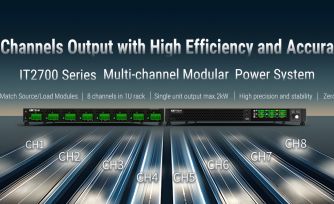
applications. The 1U frameless chassis IT2702 can accommodate up to four 500 W bidirectional source modules, with each channel
independently controlled and electrically isolated.
2. High-Precision Simulation and Professional Testing
Functions:
The IT2700 Multi-channel Modular Power System come standard with built-in
battery models, allowing seamless simulation of battery charge and discharge
cycles. The SMU modules offer nanoamp-level precision far beyond ordinary power
supplies, with seamless range switching, providing high-accuracy solutions for
low-power applications such as smart wearables and medical electronics.
3. Flexible Series and Parallel Capability:
The IT2700 Multi-channel Modular Power System features a flexible dual-master
master-slave parallel capability. Master-slave parallel operation enables
current and power expansion. For simulating series-connected cells, users can
physically connect modules in series while each channel operates independently
with battery model functions, as long as the total working voltage does not
exceed 600 V.
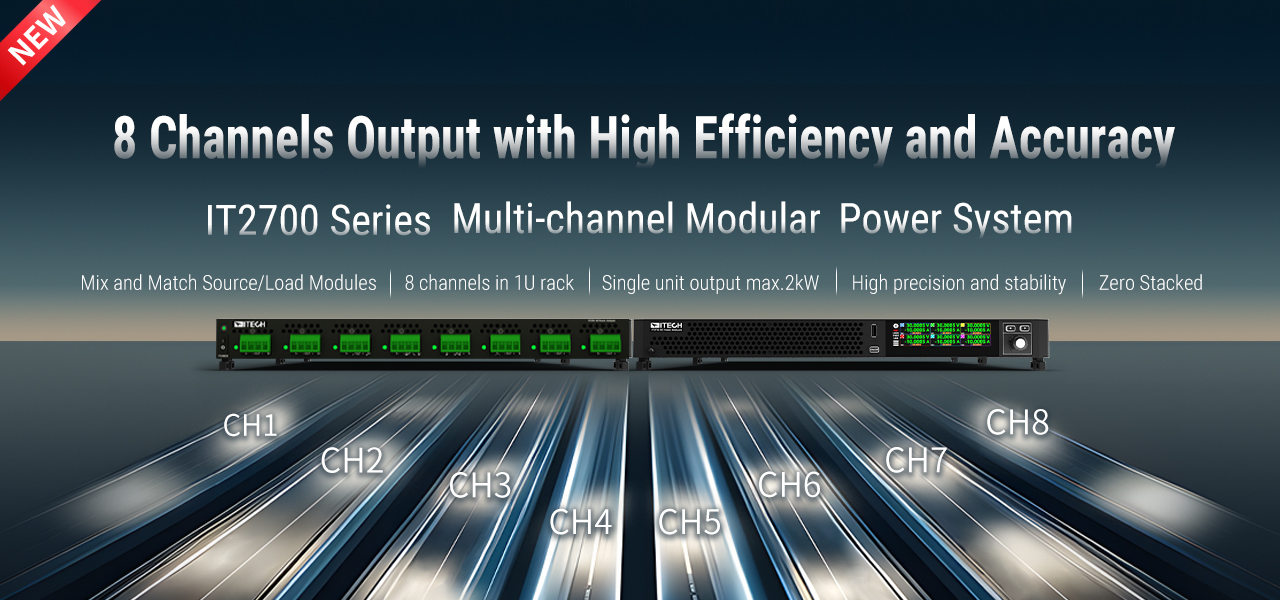
The IT2700 Multi-channel Modular Power System family is ideal for applications such as IoT terminals, chip power supply testing, automotive electronics, and smart wearables. It helps engineers gain deep insights into startup waveforms, transient responses, and power consumption characteristics, comprehensively improving testing efficiency and accuracy.