Simulation of Power Grid Abnormalities Using ITECH Grid Simulators
Why Simulate Power Grid Abnormalities? In testing power supplies or power electronics products, simulating power grid abnormalities is essential because real-world power grids are not ideal—they contain various disturbances and faults. Such simulations are critical to ensure the reliability, safety, and compliance of power electronic equipment, such as inverters, UPS, PV inverters, and EV charging stations.
1. Ensure Reliable Operation Under Real-World Grid Conditions
The power grid is not an ideal source: real grids may experience voltage sags, swells, interruptions, harmonics, frequency fluctuations, and unbalances. These abnormalities can be caused by short circuits, large load switching, lightning, or equipment failures. Equipment must withstand these conditions; if devices are tested only under ideal conditions, encountering grid disturbances in the field may lead to downtime, damage, or even safety hazards. Simulating these abnormalities allows engineers to verify the immunity of devices.
2. Compliance with International Standards and Regulations
Industrial equipment must meet electromagnetic compatibility (EMC) standards. For example, IEC 61000-4-11/34 specifies immunity tests for voltage dips, interruptions, and other disturbances, ensuring that devices do not adversely affect the grid or other equipment.
3. Verification of Protection Functions and Fault Ride-Through Capability
Key protection mechanism testing: Abnormal conditions such as overvoltage, undervoltage, overfrequency, and underfrequency are simulated to verify whether the device can detect these issues in time and take protective actions (e.g., disconnecting the output, issuing alarms).
Fault ride-through (LVRT/HVRT) requirements: In the field of renewable energy generation, grid codes require inverters to remain connected for a certain period during grid voltage sags (Low Voltage Ride Through, LVRT) or swells (High Voltage Ride Through, HVRT) to support grid stability. This functionality must be validated through simulation tests.
Additionally, these tests can effectively reduce on-site fault risks and economic losses in specific scenarios. For example, a photovoltaic inverter failure caused by grid anomalies could shut down an entire power plant, resulting in significant financial losses.
Ensuring critical facility power supply: UPS systems used in data centers, hospitals, and other critical facilities must switch seamlessly during grid disturbances. Testing is the only way to ensure their reliability.
In essence, simulating grid anomalies in power electronics testing reproduces harsh real-world operating conditions in a controlled laboratory environment. This step is indispensable for transforming products from design to reliable application. As the share of renewable energy increases and grid complexity grows, the importance of such testing will become even more prominent.
How does ITECH simulate abnormal grid conditions?
1. Standard Regulatory Testing
The IT7900 Series Grid Simulator, 350V model, provides standard test waveforms that comply with IEC 61000-4-11/4-13/4-14/4-17/4-27/4-28/4-29 regulations. Users can directly call these waveforms when performing regulatory compliance testing.
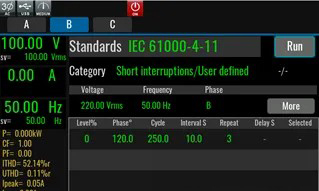
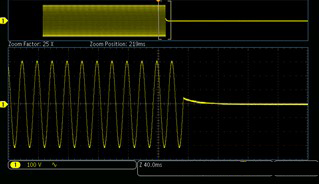
IT7900 measured waveforms complying with IEC 61000-4-11 standards
This feature not only provides standard waveforms that meet regulatory requirements, but also supports customization. Users can create their own waveforms based on specific regulatory items to perform extended compliance testing on the DUT.

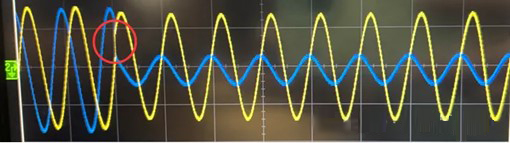
Test requirements and measured results of an energy storage customer
3. Grid Simulation and Emulation
If a customer wants to simulate the actual local grid conditions, they can use the voltage signal acquisition and emulation function. The IT7900 Series Grid Simulator can act as a data acquisition device, capturing voltage variation signals from other instruments.
With this function, users can record the real grid voltage variations of the device under test and then use the import function to load the captured waveforms into the IT7900, reproducing the actual grid conditions.
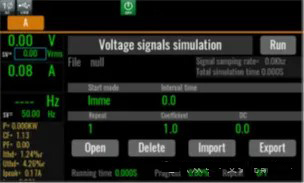
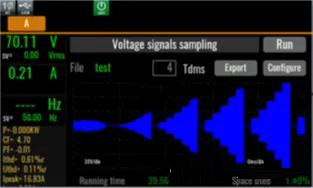
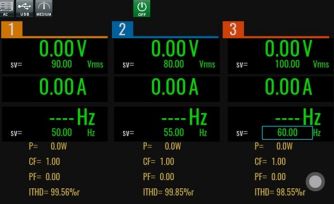
IT7900 Signal Acquisition and Simulation Interface
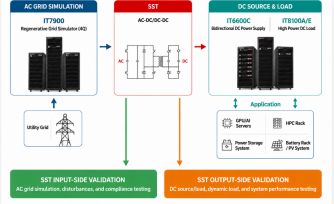
The IT7900 Series Grid Simulator represents a new generation of programmable, full four-quadrant grid simulators. It can also function as a four-quadrant power amplifier, making it suitable for testing various grid-connected products such as PCS, energy storage systems, microgrids, BOBC (V2X), and PHiL simulations.
The IT7900 adopts SiC technology and provides a professional islanding test mode. Users can configure R, L, C, as well as active and reactive power parameters to simulate nonlinear grid loads, enabling anti-islanding protection certification testing. It also features energy recovery, offering 100% current absorption, with energy fed back to the grid, saving electricity and reducing heat dissipation costs.
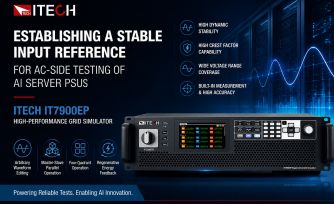
The IT7900 series offers multiple models: a 1U panel-less version and a 2U touchscreen version with power up to 6 kVA, ideal for system integration. The 3U model reaches 15 kVA, and master-slave parallel operation allows easy power expansion up to 960 kVA. Its versatile operating modes support single-phase, three-phase, inverse-phase, and multi-channel testing. In inverse-phase mode, the voltage can be extended up to 200% of the rated voltage. Powerful arbitrary waveform editing allows simulation of various grid disturbances, making it an ideal choice for testing and R&D laboratories.
High-voltage models of the IT7900 reach 700 V L–N and can even meet 1050 V L–N, providing enhanced performance for high-voltage ride-through testing and industrial power supply applications. The IT7900E Series offers a 3U/21 kVA high-power-density solution. The IT7900P/EP Series high-performance grid simulators operate in source mode as IT7900, and in sink mode offer the full IT8200 AC/DC electronic load functionality.
|
For more information, pls. visit www.itechate.com or send email to info@itechate.com . We are always here for you. |