|
The supply current drawn by an optical module can change rapidly during power-up initialization, when its transmitter or receiver is enabled, or when it switches operating modes. The test power supply must adjust its output promptly to minimize voltage dips and overshoot so that the device under test can complete testing under stable supply conditions. For applications such as optical modules, low-voltage circuit boards, and DC–DC converters, ITECH has added four high-speed DC power supply modules to the IT2700 series. With voltage ratings of 6 V, 20 V, 30 V, and 60 V, the new modules bring fast transient recovery and small voltage deviations to a modular, multichannel test platform.
The IT2700 series high-speed DC power supply modules offer the following advantages.
1. Faster Return to a Stable Voltage After Load Changes
When load current suddenly increases, the power supply output may dip briefly. When load current suddenly decreases, the output voltage may overshoot. Evaluating transient response requires looking at both the magnitude of the voltage deviation and the time it takes for the output to return to the specified steady-state range. For optical modules and circuit boards that operate at low voltages, a transient deviation can reduce the already limited supply-voltage margin and make it harder to interpret anomalies during functional testing. Smaller voltage deviations and faster recovery help reduce the effect of the test power supply on the device under test, making results easier to interpret.
The new IT2700 high-speed DC power supply modules improve voltage recovery after sudden load changes while limiting both overshoot and dips. This makes them suitable for tests that are sensitive to power supply behavior under changing loads.
2. Measurements Show Smaller Voltage Deviations and Faster Recovery
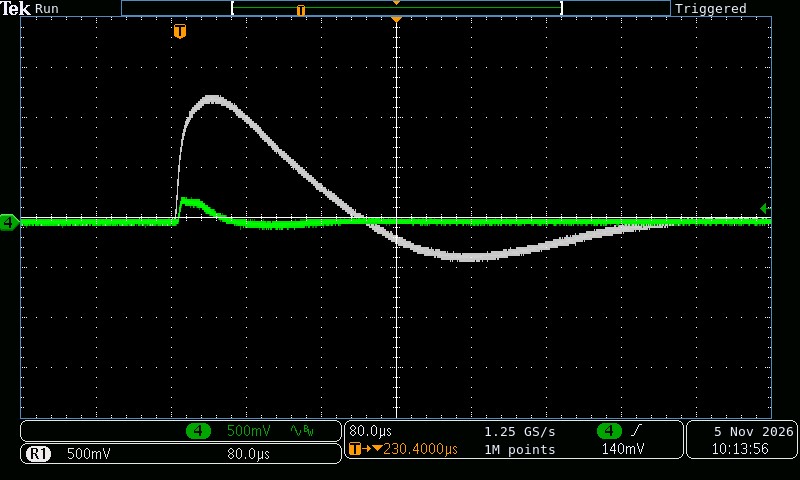
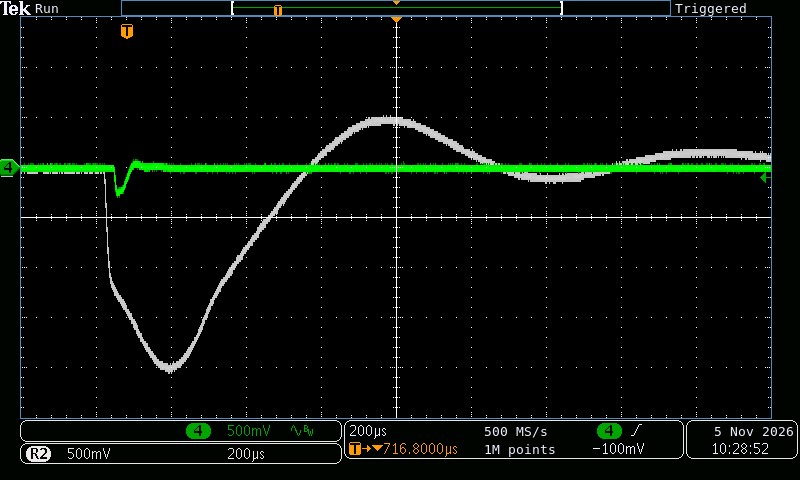
The following measurements compare the dynamic response of a standard power supply module and the IT27134A/AR high-speed DC power supply module, rated at 30 V / 20 A / 200 W, for current steps between 10% and 90%. The white trace shows the standard module, and the green trace shows the high-speed module.
Figure 1. Comparison of Positive Voltage Transients
In the positive voltage transient, the standard power supply module shows a pronounced overshoot, followed by a dip and a longer settling period. The high-speed module shows substantially less overshoot and returns close to its steady-state voltage sooner.
Figure 2. Comparison of Negative Voltage Transients
In the negative voltage transient, the standard power supply module shows a larger voltage dip, followed by a rebound and further fluctuations. The high-speed module shows a smaller dip and a shorter disturbance, with the subsequent voltage fluctuations settling sooner.
The measurements illustrate what the high-speed module offers. When the load changes rapidly, the output voltage deviates less and settles faster. For devices and circuit boards that repeatedly switch operating states, this helps provide more stable, repeatable supply conditions.
3. Four High-Speed Modules for Different Power Requirements
Voltage, current, and power requirements vary by device under test. The four new high-speed DC power supply modules address the test needs of the applications below.
|
High-Speed Power Supply Module
|
Specifications
|
Typical Applications
|
|
IT27131A / IT27131AR
|
6 V / 30 A / 180 W
|
Optical modules, low-voltage digital boards, and support circuits for optoelectronic devices
|
|
IT27134A / IT27134AR
|
30 V / 20 A / 200 W
|
12 V and 24 V boards, communications modules, and input power for DC–DC converters
|
|
IT27153A / IT27153AR
|
20 V / 50 A / 500 W
|
Low-voltage/high-current DC–DC converters, power boards, and power management circuits
|
|
IT27135A / IT27135AR
|
60 V / 10 A / 200 W
|
48 V communications equipment, industrial control circuits, and DC–DC converters with 48 V inputs
|
4. Optical Modules and Other Applications with Changing Power Demands
Testing optical modules and optoelectronic boards. For optical modules that undergo repeated initialization, enable-state switching, and operational verification, stable supply voltage helps reduce the impact of power disturbances on functional assessments. A high-speed module can power a single device under dynamic conditions. With the IT2700 chassis configured for multiple independent channels, the setup can be expanded to support multi-station testing and burn-in.
Verifying DC–DC converters and power management circuits. A change in the output load on a DC–DC converter can also change its input current. An input power supply with faster recovery and smaller voltage deviations helps keep input conditions stable, making it easier to evaluate the converter’s own voltage regulation and dynamic response. The 20 V / 50 A / 500 W module offers higher single-channel current and power for low-voltage, high-current applications.
Testing communications equipment and industrial control boards. For boards powered at 12 V, 24 V, or 48 V, the appropriate high-speed module can be selected based on operating voltage and power requirements. The platform’s programmable outputs and sequencing let users coordinate multiple supply rails and operating-state changes, providing repeatable conditions for functional verification and automated testing.
5. From a Single High-Speed Channel to a Platform with Hundreds of Channels
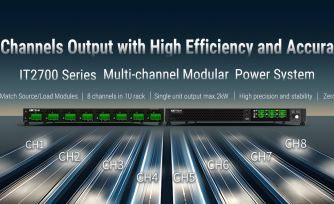
The IT2700 combines single-channel performance with modular expansion. An eight-slot chassis populated with single-slot modules can accommodate up to eight independent channels in 1U of rack space. With multiple chassis and a suitable rack configuration, a single rack can accommodate up to 240 channels. The new and existing modules can be installed in the same chassis, with each channel isolated and operating independently.
The platform supports module synchronization, sequencing, and channel grouping, and provides LAN, USB, CAN, and digital I/O interfaces. The PV2700 PC software lets users configure parameters, view waveforms, and log data across hundreds of channels, making it easier to scale from single-sample verification during R&D to multi-station automated testing.
The IT2700 series modular multichannel source and load system offers ultra-high power density. Its 1U chassis accommodates a mix of DC power supplies, bidirectional power supplies, regenerative DC loads, and precision source measure units (SMUs). Modules support synchronization and sequencing, and identical modules can be connected in series or parallel. LAN, USB, CAN, digital I/O, and free PC software come standard. The system is suited for integration into automated test equipment (ATE) for R&D, design verification, and manufacturing. Applications include DC–DC modules, communications power modules, power devices, computing, communications, and consumer electronics (3C) products such as mobile phones and printed circuit board assemblies (PCBAs), battery simulation and testing, optoelectronic chips, and power management chips. The four new high-speed DC power supply modules offer flexible configurations for optical modules, circuit boards, and power modules, from R&D through volume testing.
|