How to Meet the Low-Voltage, High-Current Dynamic Response Testing Requirements of AI Server DC-DC Converters — ITECH IT8100A/E High-Performance Electronic Load Solution
Driven by the exponential growth in AI computing demand, data centers and AI servers are undergoing a fundamental architectural transformation. As the core computing engine, GPUs have evolved from consuming several hundred watts to several kilowatts, with peak currents approaching 1,000 A per device. This trend is reshaping server thermal design and power distribution strategies while redefining the performance requirements of the Voltage Regulator Module (VRM) located adjacent to the GPU.
GPU Power Architectures and Key Test Focuses
1. Traditional Architecture: 12 V Bus → VRM
- Challenges: High current (700 A+) on the 12 V bus leads to significant power loss and poor transient performance.
2. Mainstream Architecture: 48 V/54 V → Power Distribution Board (PDB) → 12 V → VRM
(e.g., ORv3, NVIDIA DGX platforms)
- Key Test Focuses:
- 48 V bus voltage regulation
- PDB current sharing
- 12 V high-current performance
- High-speed transient response of the VRM
3. Next-Generation Architecture: 800 V HVDC → 12 V → Vertical Power Delivery (VPD)
(e.g., NVIDIA MGX and next-generation AI computing centers)
- Key Test Focuses:
- 800 V insulation and withstand voltage
- LLC converter efficiency
- Dynamic transient performance of the VPD architecture
Traditional low-voltage bus architectures are increasingly constrained by excessive conduction losses and thermal challenges associated with high-current transmission, making them unsuitable for next-generation high-power AI computing systems. As a result, 48 V/54 V intermediate bus architectures have become the industry standard, delivering an optimal balance between efficiency and power density through multi-stage power conversion. These architectures are now widely adopted in high-density AI servers and computing clusters.
Looking ahead, 800 V HVDC architectures are emerging as the preferred solution for hyperscale AI data centers. By simplifying the power conversion chain and significantly reducing transmission losses, they enable megawatt-class power delivery per rack.
Regardless of the system architecture, the GPU DC-DC converter remains the critical component responsible for precise voltage conversion and stable high-current delivery, serving as the foundation for reliable AI accelerator operation.
For high-power GPU applications, DC-DC converters and power modules are characterized by low output voltage, ultra-high output current, and extremely high conversion efficiency. These devices must support multiple bus voltage levels while accurately stepping down the voltage to the GPU operating range and delivering kiloampere-level output currents with high efficiency across the entire operating range.
To address the demanding load characteristics of modern GPUs, the industry has established comprehensive and rigorous qualification requirements for DC-DC converters. Critical evaluation items include:
- High-speed dynamic response under rapid load transients
- Output voltage deviation and recovery time during sudden load changes
- Voltage regulation accuracy across the full load range
- Load regulation and output ripple performance
- Conversion efficiency
- Protection functions
- High- and low-temperature reliability and endurance testing
These tests ensure the overall performance and long-term reliability of the power converter.
To meet these testing requirements, ITECH provides a comprehensive solution combining the IT-M3900D Series Programmable DC Power Supply with the IT8100E High-Current Electronic Load. This solution covers the two key aspects of DC-DC converter validation:
- Low-voltage input power source simulation
- Dynamic GPU load simulation
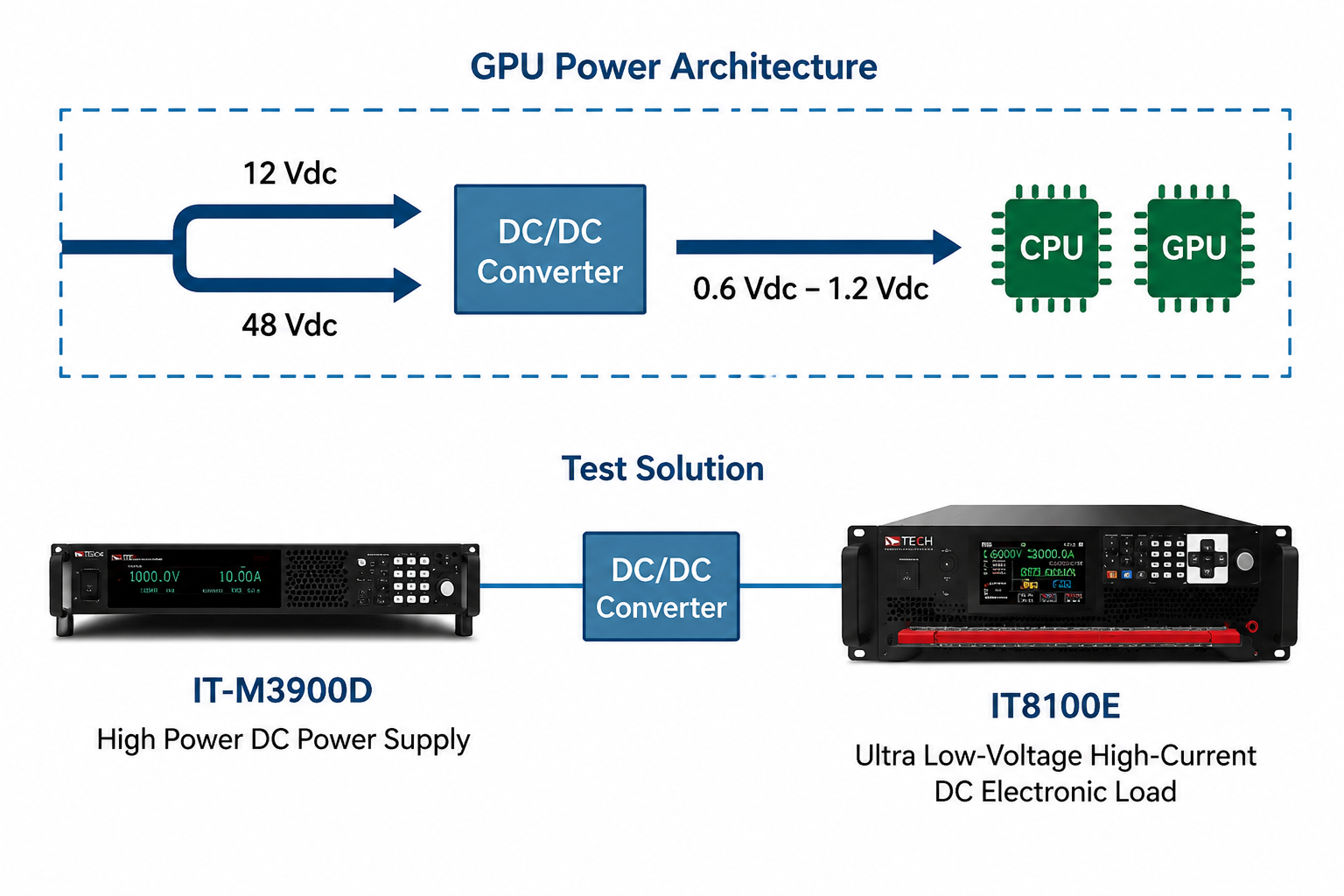
Figure 1: ITECH AI Server DC-DC Converter Test Principle Diagram
Advantages and Product Features of the ITECH Solution
? IT-M3900D Series High-Power Programmable DC Power Supply
- Compact design: 1U @ 6 kW, 2U @ 12 kW, improving space utilization
- Voltage range: 10–1500 V, Current range: 8 A–1020 A
- CC/CV priority setting function for different DUT characteristics
- Built-in arbitrary waveform generator to simulate abnormal power supply conditions
The IT-M3900D series features high power density and wide output range, enabling simulation of 48 V and 12 V bus environments within a compact footprint. Its CC/CV priority function allows users to switch control loop response modes according to different DC-DC module startup behaviors, preventing voltage overshoot and improving test safety and compatibility.
? IT8100E Series Ultra-Low Voltage High-Current DC Electronic Load
- Low-inductance design for optimized high-speed dynamic load response
- 60 V rating, designed for AI server applications; capable of sinking 2400 A at 0.24 V ultra-low voltage
- High dynamic slew rate: 75 A/μs, simulating high-speed operating conditions
- Three current ranges covering no-load, half-load, and full-load test scenarios
The IT8100E series high-speed electronic load provides core support for AI server DC-DC dynamic testing. With extremely low operating voltage and ultra-high current slew rate, it accurately reproduces current transients caused by GPU workload transitions between active and idle states. The three-range current design enables high-precision measurement from mA-level standby current to kA-level full load, covering full operating conditions of DC-DC converter validation.
System-Level Testing Capability
The ITECH test solution addresses two key requirements in the evolution of AI server power architectures:
- Input-side compatibility validation for next-generation power systems
- High dynamic load emulation capability for ultra-fast transient response testing
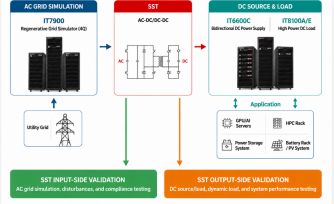
In addition to DC-DC converter testing, ITECH also provides complete AI server test solutions for PSUs, BBUs, and SST systems. Through coordinated AC/DC source and load integration, ITECH delivers a comprehensive and industry-focused validation approach for verifying transient response, efficiency, and stability of next-generation AI computing power systems.
For more information, please visit: https://www.itechate.com